

 Animal Crossing New Horizons Money Tree Guide – How to Maximize Bell Growth
Money Trees are one of the most reliable passive income sources in Animal Crossing: New Horizons. However, many players waste millions of Bells by planting the wrong amounts due to widespread myths about guaranteed returns.
According to the official Animal Crossing: New Horizons Companion Guide, the game employs a specific probability system that determines your yield. To build a prosperous island efficiently, you must understand this system. This guide provides the definitive strategies for planting Money Trees, ensuring you never lose Bells and consistently grow your wealth.
The Core Mechanic: How the Probability Works
Before you dig up that glowing spot, you need to understand the mathematical formula behind the tree. The game calculates your return based on the amount you bury, with a safety net built in to prevent total loss.
| Amount Planted | Outcome Mechanism |
| ≤ 1,000 Bells | 100% chance to harvest 3,000 Bells (3x return). |
| 1,000 – 9,999 Bells | 70% chance to harvest 3,000 Bells / 30% chance to harvest 3x the amount planted. |
| ≥ 10,000 Bells | 70% chance to harvest 30,000 Bells / 30% chance to harvest 3x the amount planted. |
Key Takeaway: If you plant 10,000 Bells or more, the "worst case scenario" is always a return of 30,000 Bells. You will never lose your principal investment if you stay within these parameters.
Step-by-Step Planting Process
1. Locate the Golden Spot
Each day, your island will spawn one glowing golden fissure. Dig it up with your shovel. You will retrieve 1,000 Bells, leaving behind a glowing hole.
2. Select Your Investment Strategy
Open your inventory, select your Bells, and choose "Take out X Bells." Place the desired amount into the glowing hole. A nursery sapling will appear immediately.
3. Transplanting (Optional)
If the location isn’t ideal for your orchard layout, you can use your shovel to dig up the sapling (the small nursery tree) and replant it anywhere else. Once the tree is fully grown, it cannot be moved without eating fruit.
4. Growth Cycle
The tree takes 4 days to fully mature. It produces Bell bags only once. After harvesting, it turns into a standard hardwood tree. You can then chop it down or keep it for aesthetics.
The Three Investment Strategies
To maximize efficiency, you must choose a strategy that matches your risk tolerance and current wealth.
1. The Safe Investor (Highly Recommended)
Amount to Plant: 10,000 Bells
Guaranteed Return: 30,000 Bells
Net Profit: +20,000 Bells
Why it works: This is the most efficient method in the game. By ignoring the 30% chance for a triple jackpot, you secure a 200% profit margin every single day with zero variance. It is the fastest way to build a stable fortune without gambling.
2. The Risk-Neutral Gambler
Amount to Plant: 30,000 Bells
Worst Case: 30,000 Bells (Net Profit: 0)
Best Case: 90,000 Bells (Net Profit: +60,000)
Why it works: This strategy eliminates the fear of loss. You either break even or make a significant profit. It is ideal for players who have a moderate bankroll and want a chance at a jackpot without the sting of losing money.
3. The High-Risk Lottery
Amount to Plant: 99,000 Bells
Worst Case: 30,000 Bells (Net Loss: -69,000 Bells)
Best Case: 297,000 Bells (Net Profit: +198,000)
Why it works: Only attempt this if you have a massive surplus of Bells. Statistically, you will lose money 70% of the time. While the 30% payout is exciting, the long-term expected value is negative compared to the Safe Investor strategy.
Expert Tips for Optimization
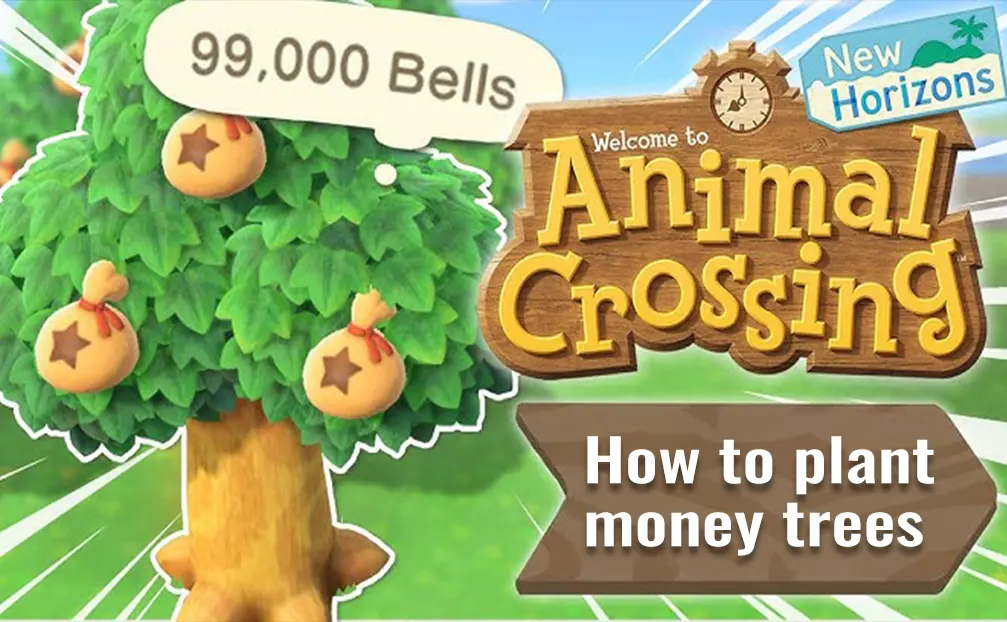
- Avoid the "99k Myth": You may have seen videos claiming you can plant 99,000 Bells for a guaranteed triple return. This is false. The 70/30 split applies to all amounts above 10,000 Bells. Planting 99k results in a loss 70% of the time.
- Daily Consistency: Since only one Golden Spot spawns per day, consistency is key. Logging in daily to plant your 10,000 Bells yields a steady 140,000 Bells per week in pure profit from this method alone.
- Orchard Layout: To avoid clutter and make harvesting easier, designate a specific grid for your Money Trees. Because they revert to regular trees after harvest, plant new saplings in a "rotation" system—dig up the old hardwood trees and replace them with the new saplings.
- Watering is Cosmetic: Unlike flowers, watering Money Trees does not affect yield or growth speed. It only triggers a visual sparkle effect.
Frequently Asked Questions
Q: Can I plant 1,000,000 Bells?
A: Yes, you can physically bury that amount. However, the tree will still adhere to the 70/30 rule. 70% of the time, you will only get 30,000 Bells back, resulting in a catastrophic loss of 970,000 Bells. It is never recommended.
Q: How long does it take for a Money Tree to grow?
A: It takes 4 days to reach full maturity. The stages are: Day 1 (Sapling), Day 2 (Young Tree), Day 3 (Medium Tree), Day 4 (Fully Grown with Bell Bags).
Q: Can I move a Money Tree after it has grown Bells?
A: No. You can only safely move the tree while it is a sapling (Days 1-2). Once it reaches the medium stage or starts bearing Bells, moving it requires eating fruit and destroying it.
Q: Does the glowing spot reappear if I don’t plant money?
A: Yes. If you dig up the 1,000 Bells but do not bury money in the glowing hole, the hole will disappear by the next day, and a new glowing spot will spawn elsewhere on the island.
Q: What happens if I bury a Money Tree too close to an obstacle?
A: The tree will fail to grow. Ensure there is a full 3x3 grid of empty space around the sapling to guarantee healthy growth.
Summary
The key to wealth in Animal Crossing: New Horizons is not luck—it is understanding the game's mechanics. While the temptation to bury 99,000 Bells is strong, the data shows that the most efficient, high-yield strategy is to bury 10,000 Bells every day. This guarantees a steady 20,000 Bell profit per tree, allowing you to fund infrastructure projects, island decor, and villager gifts with consistent, predictable income.

